2025 Photomicrography Competition

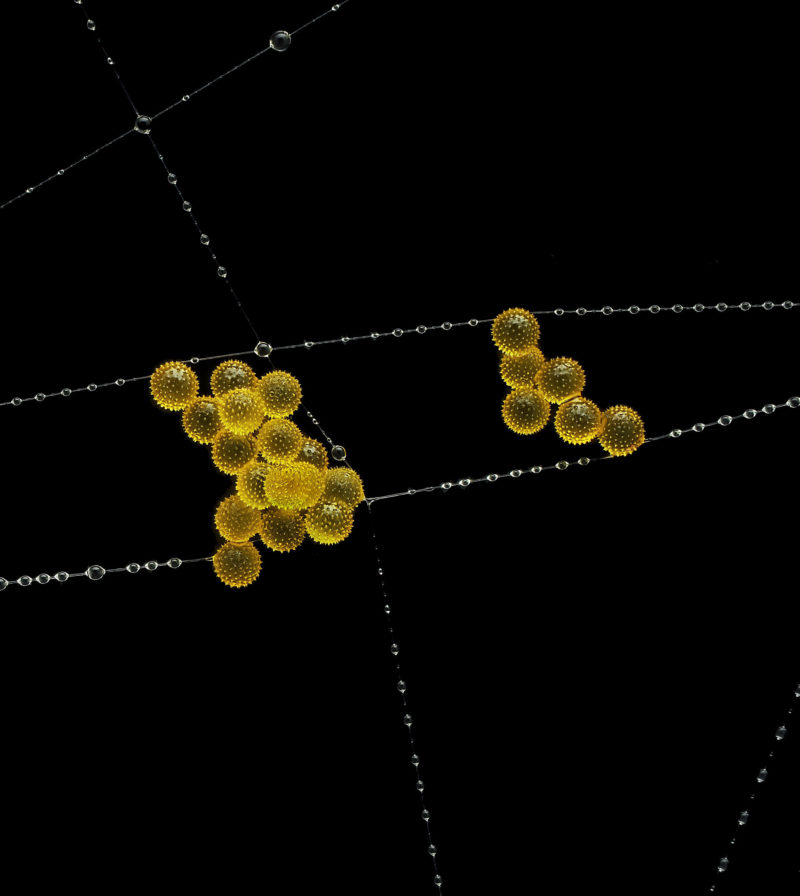
3rd Place
Pollen in a garden spider web
John-Oliver Dum
- Affiliation
- Medienbunker Produktion
Bendorf, Rheinland Pfalz, Germany
- Technique
- Image Stacking
- Magnifaction
- 20X (Objective Lens Magnification)
 Share
Share Tweet
Tweet Pin-It
In Their Own Words
What does being a winner of the Nikon Small World competition mean to you?
Nikon Small World is, in my view, the most prestigious competition in the field of scientific-aesthetic photography. In Germany, we have a saying: “This is where the wheat is separated from the chaff.” I never dreamed of achieving a 3rd place, which makes this recognition even more meaningful to me. It’s wonderful to see the amount of work and dedication behind such an image being acknowledged on an international level.
Can you describe in further detail (beyond what’s written in the caption), in a way the general public would understand, what is happening in your winning image?
The image deals with the topic of vegan nutrition in spiders. In my lectures, I like to present fascinating subjects, and this photo is part of a series showing only objects found in spider webs — such as scales of eaten butterflies, tiny midges, spores, and even pollen. It’s a microcosm in constant transformation throughout the seasons.
Recent studies indicate that spiders may also consume plant-based food sources like pollen, especially in times of scarcity or incidentally as bycatch.
To create this image, I observed spiders in my wild garden over two years and examined samples of their webs to build an educational image series for my lectures as a private educator.
As Nikon Small World celebrates its 51st anniversary, how do you feel about being part of such a long-standing tradition that highlights the beauty and importance of scientific discovery through microscopy?
It feels good to make a contribution to the scientific community — especially in times when modern science is sometimes viewed with skepticism. Through my images, I want to inspire people to focus on the small things in life, to take time to observe carefully, to go out into nature — the very place where these images originate — and to realize that we need to protect it in order to continue benefiting from its healing power. That’s part of the purpose of these images: to inspire and hopefully engage the next generation of explorers and researchers.
Why do you think competitions like Nikon Small World, and scientific communication in general, are important?
Because this competition fosters international exchange. I’ve been participating for four years now and have met many other photographers from around the world. Over time, we’ve built a strong technical and scientific network — something that wouldn’t exist without the Nikon Small World competition, which plays a crucial role in this field. Perhaps one day, it will even be possible to organize an international meeting for all of us.

