2025 Photomicrography Competition

14th Place
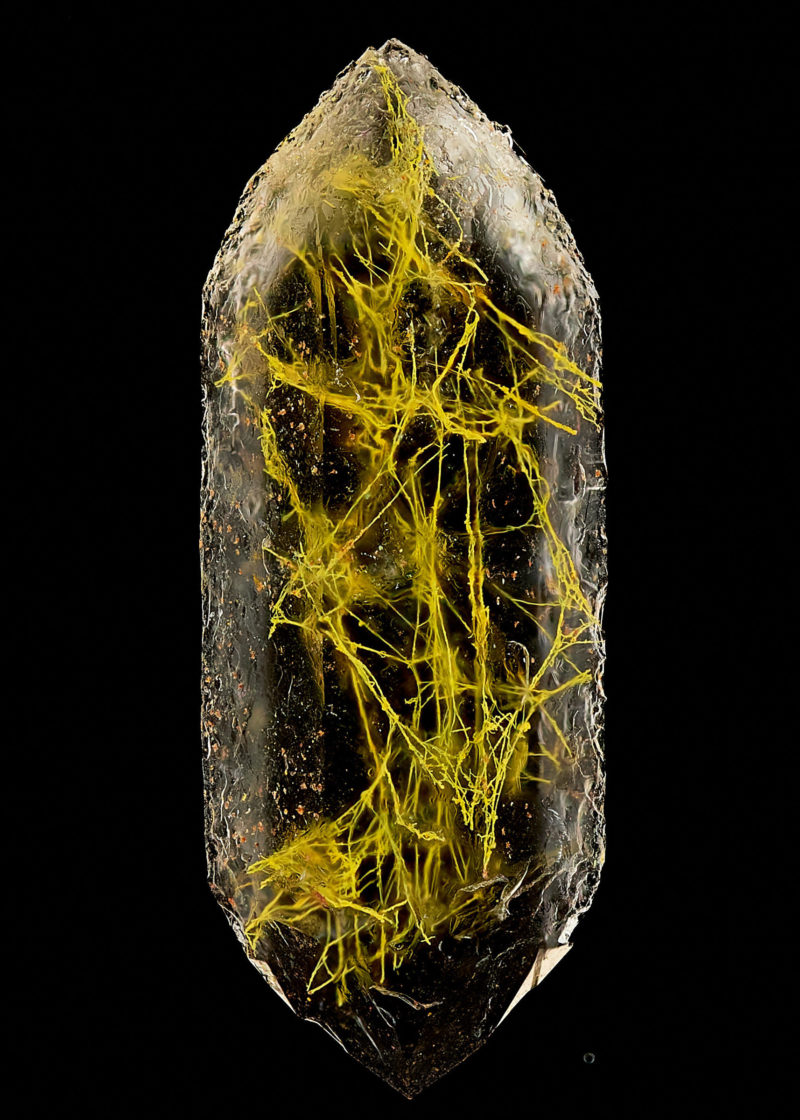
Quartz with biotic goethite filaments
Manfred Heising
- Affiliation
- LWL Museum of Natural History Münster
Münster, Northrhine-Westphalia, Germany
- Technique
- Magnifaction
- 5X (Objective Lens Magnification)
 Share
Share Tweet
Tweet Pin-It
In Their Own Words
What does being a winner of the Nikon Small World competition mean to you?
It is a great honor for me to be among the winners of the Nikon Small World competition 2025, especially that my image will be featured in the calendar. It means a lot to me that my fascination I experience with photomicrography can reach and inspire others as well. Under the microscope, it becomes visible how incredibly complex and at the same time truly aesthetic this hidden world is.
Can you describe in further detail (beyond what’s written in the caption), in a way the general public would understand, what is happening in your winning image?
The image shows a 3.2 mm long quartz crystal with two crystal tips containing filamentous goethite inclusions – structures preserved for millions of years. Goethite is an iron oxide mineral. The delicate filaments range in diameter from 0.005 to 0.02 millimeters. Normally, these formations remain hidden inside the mineral, but they become visible only under a microscope.
Such crystals with goethite filaments are mineralization formed in ancient karst cavities by ascending hot solutions.
About forty years ago, a hypothesis was published suggesting that these goethite filaments could be signatures of fungi. As methods to detect biogenic signatures on Mars were developed, numerous studies were published describing similar filaments found in deposits with different host matrices. These studies results now support the assumption that some of these filament types are indeed of biogenic origin, presumably formed by iron-oxidizing bacteria.
Why do you think competitions like Nikon Small World, and scientific communication in general, are important?
What makes the Nikon Small World competition so remarkable is that it has been combining science and aesthetics for more than 50 years. Being part of this tradition fills me with great pride.
The Nikon Small World Photomicrography Competition is one of the most significant competitions of its kind worldwide, making photomicrography accessible to a broad audience.
Such competitions demonstrate why science communication matters: images can spark curiosity, raise questions, and inspire people. The competition also provides a great opportunity to connect with others and learn from their diverse approaches and techniques. For me, it is also a chance to showcase a regional geological peculiarity that would otherwise remain hidden to the naked eye.

