Meet the JudgesMeet the Judges

Meet the 2026 Judging Panel
Nikon Small World showcases brilliant imagery and artistic feats in science and the unseen world around us. Each year, the Nikon Small World judging panel plays an integral role in selecting the images and videos that best illustrate the combined wonders of science and artistry. The competition has grown and evolved significantly over the past half century, necessitating a judging panel whose combined expertise matches the unique prowess and skill of the entries they are tasked with reviewing.
Nikon strives to select a panel that demonstrates a range of expertise — a team that can evaluate a photo or video based on technical prowess, scientific significance, aesthetic appeal, and power to convey a story to the viewer. In this article, you’ll meet the members of the 2026 judging panel who reviewed thousands of submissions from around the world to select this year's winners. We are delighted to introduce the esteemed judging panel of the 52nd annual Nikon Small World competition.
Quinten Geldhof brings a unique blend of engineering, science communication, and creative storytelling to the 2026 Nikon Small World judging panel. As a technical designer at the Museum of Science in Boston, Massachusetts, Geldhof designs, tests, and builds interactive exhibits that inspire curiosity and lifelong learning in visitors young and old. His journey to the field began early, through volunteer work at the museum as a young teenager and time spent learning alongside his father, an electromechanical engineer. Together, they tackled projects ranging from model trains and motorcycles to Lego builds — experiences that helped cultivate his lifelong fascination with understanding how the world works.
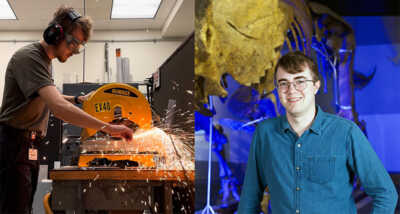
Geldhof cutting steel rod on a chop saw to use for an exhibit at the Museum of Science.
After graduating from Franklin Cummings Tech with a degree in mechanical engineering technology, Geldhof joined the Museum of Science full time. In 2022, he expanded his science communication efforts by launching his Instagram account, @microhobbyist, where he shares microscopy videos that reveal the hidden complexity of the microscopic world. What began as a personal hobby has grown into a platform with more than 115,000 followers, reaching hundreds of thousands of viewers and encouraging broader public engagement with science.
As both a microscopy content creator and a previous Nikon Small World in Motion top 5 winner, Geldhof brought a distinctive, multifaceted perspective to this year's judging process. In his experience, the most memorable entries were those that combined visual appeal with a compelling story. “While striking imagery is essential when evaluating hundreds of submissions,” he said, “I believe the strongest entries are often distinguished by a rare moment, an unexpected observation, or a novel technical approach that offers viewers a fresh way of seeing the microscopic world.”
Reflecting on this year's competition, Geldhof was particularly impressed by the creativity and diversity of the submissions. Among the entries that stood out most were the first-place-winning image and a video capturing a remarkable interaction between a Dileptus and a nematode, including an unexpected moment when part of the Dileptus separated from its main body and drifted away. “Experiences like these underscore the power of microscopy to reveal phenomena that might otherwise go unnoticed.”
A passionate advocate for making science accessible to broader audiences, Geldhof believes the intersection of science and art plays a vital role in fostering public curiosity and appreciation for research. "The beauty in the natural world, presented through images like those seen in the Nikon Small World competition, creates something tangible for people to connect with and be curious about,” he said, noting his gratitude for the curiosity the competition inspires, which in turn allows for more support for learning and the sciences.
Outside of his judging responsibilities, Geldhof continues to produce microscopy content and collaborate with the Museum of Science on educational initiatives. His advice to aspiring scientists, artists, and explorers is simple: follow your curiosity. “As Nikon Small World demonstrates year after year, extraordinary worlds exist all around us, even within a single drop of pond water, and they’re just waiting to be discovered.”
Joe Dragavon, Ph.D.
Joe Dragavon, Ph.D., brings decades of experience in microscopy, scientific research, and shared research resources to the 2026 Nikon Small World judging panel. As director of the BioFrontiers Institute's Advanced Light Microscopy Core and director of core facilities and shared instrumentation at the University of Colorado Boulder, Dragavon oversees one of the institution's most widely used scientific resources, supporting researchers across a broad range of disciplines while helping to advance microscopy education and training.
While his career ultimately led him to the forefront of imaging science, Dragavon describes his path as anything but linear. After earning a bachelor's degree in chemistry from the University of Puget Sound, where he studied the phosphorescent lifetimes of oxytocin and vasopressin, he pursued a Ph.D. in analytical chemistry at the University of Washington. His doctoral work focused on developing a single-cell isolation system that monitored oxygen consumption rates using fluorescence lifetime imaging.
From there, Dragavon's scientific journey took him across the globe. He completed postdoctoral research at the University of Hull in the United Kingdom before joining the Institut Pasteur in Paris, where he worked within the renowned Plate-Forme d'Imagerie Dynamique under the mentorship of Dr. Spencer Shorte. There, he first discovered the world of shared research resources and developed a passion for helping other scientists succeed through access to advanced imaging technologies.
That experience proved transformative. Working alongside researchers studying a wide range of biological questions, Dragavon found himself captivated not only by the science itself but also by the opportunity to help others visualize what would otherwise remain invisible. Inspired by the collaborative environment and the remarkable diversity of samples passing through the facility, he realized he had found his professional calling.
In 2014, Dragavon joined the University of Colorado Boulder to lead the newly established Advanced Light Microscopy Core at the BioFrontiers Institute. Since then, he has trained more than 1,000 students, supported over 120,000 hours of microscope use, and helped grow the facility into a critical institutional resource. Inspired in part by Nikon Small World, he also launched the annual CU Up Close Image Competition in 2016, providing researchers at Colorado Boulder with an opportunity to showcase the beauty and impact of their microscopy work. In 2023, he expanded his leadership responsibilities, becoming director of core facilities and shared instrumentation for the university's Office of the Vice Chancellor for Research. He currently serves as president of the Association of Biomolecular Resource Facilities (ABRF), where he works alongside colleagues to advance core facilities and shared research resources worldwide.
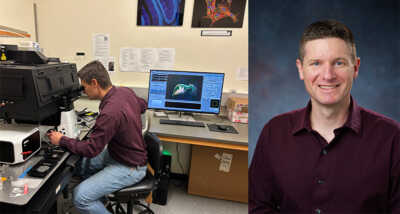
Dragavon posing with one of the Nikon microscopes at the University of Colorado BioFrontiers Institute.
As a Nikon Small World judge, Dragavon approached the competition from a perspective that balanced scientific appreciation with artistic wonder. While many submissions showcase groundbreaking research, he found himself drawn to images and videos that possessed a lasting visual impact — entries compelling enough to stop a viewer in their tracks and invite repeated observation. “For me, the power of an image lies not in any single technical element, but in the way the entire composition comes together to create a sense of fascination and discovery,” he said.
That sense of wonder was present throughout this year's competition. Whether viewing crystal growth, microscopic organisms interacting within their environments, or highly magnified images of insects, Dragavon was continually reminded of the extraordinary beauty hidden beyond the limits of human vision. “Everything I saw was surprising, even if I had seen it before,” he reflected. “The ability of microscopy to reveal unseen structures and processes ensures that the microscopic world never ceases to surprise and inspire.”
Serving on the judging panel was both an honor and a source of inspiration. Beyond the opportunity to review hundreds of exceptional submissions, Dragavon found renewed motivation to support the researchers and students who rely on his facility. Seeing the creativity, technical skill, and artistic vision represented across the competition reinforced the value of helping others explore and document the microscopic world.
Dragavon believes competitions like Nikon Small World play a critical role in connecting science with broader audiences. Beautiful imagery serves as a powerful gateway to scientific understanding, drawing viewers in and encouraging them to ask about what they are seeing and why it matters. He noted that while the impact of an image can be subjective, common ground can be found in the universal appreciation for a beautiful composition. “Throughout the judging process, I did my best to reside in the happy medium between the two,” he said.
Reflecting on his experience as a judge, Dragavon describes his participation in Nikon Small World as a privilege and an opportunity he would gladly embrace again. For someone who has dedicated his career to helping others see the unseen, the competition remains a powerful celebration of scientific discovery and visual storytelling.
Corey S. Powell
Award-winning journalist and editor Corey S. Powell has spent his career translating complex scientific ideas into stories that inform, inspire, and engage broad audiences. As a writer, editor, author, and science communicator, Powell has worked across nearly every form of science media, bringing together conceptual rigor with compelling storytelling to help readers better understand the world around them, and the universe beyond.
Powell began his career in science journalism during the heyday of print science magazines, holding editorial roles at Scientific American and Discover, where he ultimately served as editor-in-chief. Following his time in magazine publishing, he expanded his work through books, television, podcasts, and digital media, collaborating with Bill Nye on multiple books, television series, and the Science Rules! podcast. He later co-founded OpenMind, a Pulitzer-supported digital magazine exploring scientific controversies and misinformation, while continuing to write for publications including The Wall Street Journal, NBC News, and other national outlets.
Powell’s initial fascination with science started early. “I became obsessed with science as a young kid, and I think a part of me never stopped being that kid,” he said. Although he initially considered pursuing a career as a researcher, he soon realized his strengths lay more in communicating scientific discoveries than in conducting experiments. His first job in publishing, at Physics Today magazine, confirmed that he had found his professional community: a place where curiosity, storytelling, and discovery intersect. “The journalism world has changed completely since then, but the communal feeling is still there,” he noted.
That perspective proved especially valuable as a member of the 2026 Nikon Small World judging panel. While other judges brought deep expertise in microscopy techniques and biological research, Powell drew upon decades of experience working with photographers, illustrators, designers, and visual storytellers to evaluate entries through the lens of both scientific communication and aesthetic impact. "Being asked to apply my harshest visual judgement on those images and videos wasn't always easy, but it forced me to think deeply about the science, the imaging techniques, and the artistry,” he said.
For Powell, the most compelling submissions combined strong visual composition with an unmistakable sense of surprise. Vibrant colors, dynamic framing, and a clear subject all contribute to an image's success, but the very best entries also evoked an emotional, “harder-to-define" response, which he categorized as “a dopamine rush that comes from the sense of excitement at seeing something simultaneously beautiful, unexpected, and entirely new.”
That feeling of discovery appeared throughout this year's competition. While some entries transformed a familiar subject matter into something almost unrecognizable, many other submissions offered fresh perspectives on subjects that scientists and microscopy enthusiasts know well, including tardigrades, crystallizing minerals, and dividing cells.
Looking ahead, Powell is excited to share several new projects including "Across the Cosmos," a book collaboration with Bill Nye that pairs 100 remarkable astronomical images with essays that each reveal something unexpected about the way nature works, and "Our Invisible Universe," a book examining how advances in technology have continually expanded humanity's ability to perceive realities beyond our biological senses. The latter is joined by a companion Substack called Invisible Universe. Powell is also developing The Fermi Paradox, a podcast that explores one of humanity's most enduring scientific questions: whether we are alone in the universe.
“My interests seem only to grow more expansive over time,” he joked.
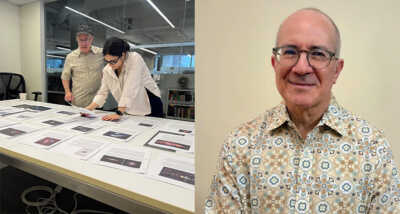
Powell and his editor composing the layout of 100 space images for the forthcoming book “Across the Cosmos with Bill Nye,” edited by Corey S. Powell. May 2027, Liveright.
Reflecting on his experience with Nikon Small World, Powell describes the judging process as both challenging and immensely enjoyable, specifically mentioning the thoughtful discussions among the judging panel, whose members brought complementary expertise and differing perspectives to every stage of the deliberations. Reviewing the remarkable breadth of creativity on display reinforced his belief that the most memorable scientific images are those which inspire wonder and invite everyone to see the world through a new, objective lens.
Meredith Sagolla, Ph.D.
Meredith Sagolla, Ph.D., has spent over two decades helping scientists harness the power of advanced microscopy to answer some of biology's most challenging questions. As director of the Center for Advanced Light Microscopy and Electron Microscopy (CALM-EM) at Genentech, she leads a team that supports research across neuroscience, oncology, immunology, and other therapeutic areas, ensuring researchers have access to the imaging technologies and expertise needed to advance the development of new medicines.
Sagolla's fascination with microscopy began early in her scientific career. In her first job after college, she used fluorescence microscopy to study plant and fungal development, immediately captivated by the ability to observe biological processes at the microscopic level. That interest continued through graduate school at the University of California, Berkeley, where she joined the laboratory of Dr. Zacheus Cande and used deconvolution microscopy to study chromosome pairing, microtubules, and diverse model organisms, including yeast and Giardia. The experience reinforced an important realization: microscopy is not confined to a single discipline, but rather serves as a powerful tool for exploring virtually any biological question.
After graduate school, Sagolla briefly worked in microscope sales before recognizing that her passion remained in the research environment. She joined Genentech's imaging facility, where she found the ideal combination of scientific discovery, technology, and education. Today, in addition to helping researchers identify the best imaging approaches for their work, she enjoys mentoring scientists and sharing her enthusiasm for microscopy with others. “My work is dedicated to providing the right technology and helping our scientists apply the best imaging approaches to their research programs, all in support of our mission to develop the next drug for our patients,” she said.
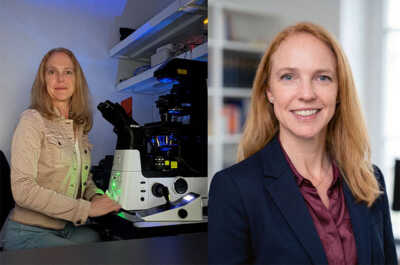
Sagolla posing with one of the Nikon microscopes at the Genentech imaging facility.
That passion shaped her perspective as a judge for the 2026 Nikon Small World competition. “The most compelling images and videos are those that spark curiosity and leave viewers wanting to learn more,” she said. “Likewise, the strongest entries reveal unexpected details within familiar specimens, transforming ordinary biological structures into extraordinary visual experiences. Rather than simply documenting a subject, the most memorable images invite exploration and inspire the reaction, ‘I've never seen that before!’"
One of the aspects she enjoyed most about judging was seeing the remarkable diversity of approaches in this year's submissions. While many entries featured specimens familiar to her through years of microscopy experience, she found that each participant brought a unique perspective to their work. The collection ranged from visually striking images captured with relatively simple instruments to technically sophisticated compositions that showcased advanced imaging methods, illustrating the many different ways microscopy can communicate both scientific discovery and artistic expression.
Serving on the judging panel also provided a rare opportunity to engage with others who share her enthusiasm for microscopy. Although her profession is highly specialized, the Nikon Small World community brings together people who appreciate the unique intersection of science, technology, and art. Reviewing the hundreds of submissions and witnessing the pride contributors took in sharing their work with the world, she said, made the experience especially rewarding.
Sagolla believes her years leading an advanced imaging facility gave her a balanced perspective when evaluating entries. Her experience helping researchers select the right imaging strategies, combined with her technical expertise in microscope design and maintenance, allowed her to appreciate both the scientific rigor behind each submission and the creative problem-solving required to produce truly exceptional imagery. “Observing the varied imaging styles that speak to people and compel them to share their work was a truly fascinating aspect of the experience,” she noted.
Part of what Sagolla appreciates most about competitions like Nikon Small World is their role in making science more accessible. While many people have heard about diseases such as cancer or parasitic infections that impact human health, relatively few have had the opportunity to see cancer cells or microorganisms up close. Microscopy transforms complex scientific concepts into compelling visual stories that spark curiosity and encourage broader public engagement with research. By revealing the beauty hidden within the microscopic world, these images demonstrate that scientific discovery is as much about creativity and wonder as it is about technical achievement.
Looking ahead, Sagolla is particularly excited about the rapid evolution of microscopy technologies — an exceptionally personal interest given her technical background in both building and maintaining microscopes. Advances in imaging techniques, new molecular labeling tools, and artificial intelligence are creating unprecedented opportunities to study cells and tissues in greater detail than ever before. She is especially enthusiastic about emerging approaches such as light sheet microscopy, which enable researchers to efficiently image biological samples in three dimensions and observe them in ways that more closely resemble the way they exist in the body.
Reflecting on her experience as a judge, Sagolla describes it as both a privilege and a pleasure. She is grateful for the opportunity to contribute to the Nikon Small World community and to help celebrate the remarkable creativity and innovation that continue to define the competition.


