For most of his professional life, 2025 Small World in Motion winner Jay McClellan has been dedicated to seeing the unseen, though his focus was not always on nature as it is now. As an industrial machine vision systems developer, McClellan’s work involved capturing and processing images in a manufacturing setting, using high-speed imaging to create advanced automated inspection systems. When he retired, McClellan traded factory floors for the natural world, applying his decades of technical expertise to the delicate art of microscopic videography.
Masters of MicroscopyMasters of Microscopy

Jay McClellan: From Manufacturing to Microscopy
Welcome to Masters of Microscopy: The People Behind the Lens, where we showcase and celebrate the individuals who are the heart of the Nikon Small World competitions. They are scientists, artists, researchers, educators, and everyday curious individuals who uncover the fascinating microscopic world around us.
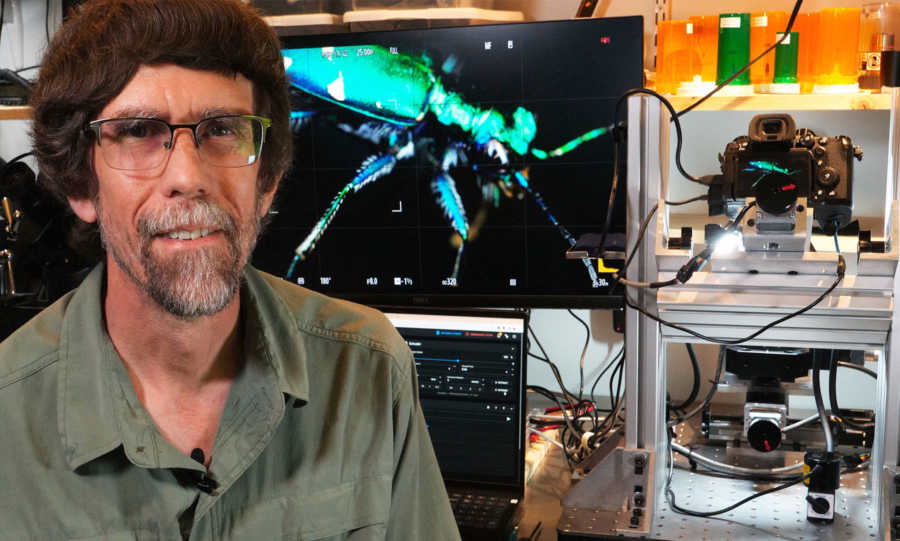
Jay McClellan and his custom-built macro/micro video rig.
“I’ve had microscopes since I was a young boy,” McClellan said. “From the first time I used one, I was fascinated by the microscopic world. There’s so much amazing detail all around us, even in something as common as a tiny weed.” Photography had also been a lifelong passion, so it was only a matter of time before the two interests converged.
McClellan’s hard work and combined interests paid off. The video that won him the first-place title in the 2025 Nikon Small World in Motion competition captures a sequence that is both scientifically fascinating and visually stunning: the self-pollination of a thymeleaf speedwell, also known as Veronica serpyllifolia. In the video, a tiny blossom opens to the morning sun, its two stamens elongating until one gracefully curls toward the pistil, dusting the stigma with pale yellow pollen.
McClellan’s video, “Self-pollination in a flower of thymeleaf speedwell (Veronica serpyllifolia),” which won first place in the 2025 Small World in Motion competition.
“This isn’t some exotic plant you have to trek into the rainforest to find,” McClellan explained. “It’s a common weed that might be growing right under your feet. I love the idea that anyone could discover beauty like this if they just looked closely.”
While the process occurring in the stunning visual may appear to be simple, filming the moment was anything but. The flowers open quickly and unpredictably, so McClellan had to anticipate their movements, using a custom-built motion-control system to keep the reproductive structures perfectly in frame. Adding rotational movement was another challenge, and one that really brought the 3D structure to life on screen. Not all flowers cooperated, and it took multiple attempts to capture a successful self-pollination. Fortunately, McClellan’s garden offered thousands of chances.
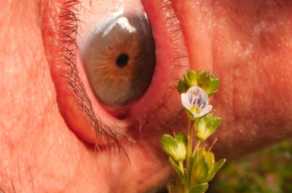
The subject of McClellan’s winning video, Veronica serpyllifolia, with McClellan’s eyeball for scale.
The shoot also showcased the advanced imaging techniques he has developed since retiring. Over several years, McClellan has engineered his own hardware and software to create focus-stacked microscopic videos, an approach that merges multiple focal planes into one crystal-clear frame. While this method is common in still photography, applying it to video requires precise frame-to-frame consistency and massive amounts of data processing. “I may capture many terabytes of raw footage for a single shot,” McClellan said. “Running the focus-stacking overnight is like waiting for Christmas morning — you never know if you’ll get a disappointment or something amazing.”
McClellan also earned an honorable mention in this year's Small World in Motion competition for his video of the dissolution and crystallization of cobalt, copper, and sodium chlorides. He has now placed four total videos in the competition since 2023, including his movie of water droplets evaporating from the wing scales of a peacock butterfly, for which he earned second place in the 2024 Small World in Motion competition.
McClellan’s curiosity and love of building and video creation extend far beyond the microscopic. He often enjoys making videos of overlanding and sailing adventures with his wife, tinkering in his workshop, and even building guitars in his free time. He’s currently working on a nature documentary project, and he hinted at new motion-control rigs and imaging techniques designed to take his microscopic filming on the road.
When asked for advice for newcomers to microscopy, McClellan recommended starting simple and learning from others. He noted that some of his early work — including an honorable mention in the 2023 Small World in Motion competition — was shot using a $22 microscope objective. “High-end optics can deliver incredible results, but creativity and technique matter more,” he said. “Communities like photomacrography.net are great places to learn.” Aspiring photomicrographers can also look to McClellan's own website, https://brainright.com/, for walk-throughs of his self-made technology and a closer look at more of his work.
For McClellan, competitions like Nikon Small World are about connection as much as they are about recognition. “The best part for me is not winning a prize,” he said, “but getting the opportunity to share my work with the world and let people see microscopic wonders in a new way.”
To stay up to date with the "Masters of Microscopy" series and receive your daily dose of Nikon Small World, follow us on Instagram, X, and Facebook. Be sure to follow Nikon Instruments for the latest updates on equipment and technology.


