Ole Bielfeldt: Finding the Extraordinary in Everyday Objects
Welcome to Masters of Microscopy: The People Behind the Lens, where we showcase and celebrate the individuals at the heart of the Nikon Small World competitions. They are scientists, artists, researchers, educators, and everyday curious individuals who uncover the fascinating microscopic world around us.
From a makeshift microscope built during lockdown to an award-winning image of an inkjet printer in action, Nikon Small World 2026 first-place winner Ole Bielfeldt approaches microscopy with unlimited curiosity and a willingness to build whatever his next idea requires.
Bielfeldt has found some of the most interesting subjects of his photographs sitting right in front of him. A printer. A matchstick. A candle. Ordinary objects that become surprisingly unfamiliar when viewed up close.
Bielfeldt, a student based in Cologne, Germany, is the creator behind macrofying, his photography and videography brand. His work combines photography, microscopy, and self-built equipment to reveal details and processes most people never see. That approach earned him first place in the 2026 Nikon Small World photomicrography competition with an image of ink droplets suspended inside an inkjet printer as it prints.
The photograph captures a moment in a process that happens millions of times every day: An ink cartridge releasing tiny droplets that travel through the air before landing on paper. At a normal viewing distance, those droplets disappear into the printed image. Bielfeldt's photograph brings them into view, revealing the machinery, motion, and imperfections inside a familiar piece of technology.
“I think it was super interesting because I didn't know how it really worked,” Bielfeldt said of the printer's internal process. “It's like it was magic, and I didn't understand it, but now I do.”
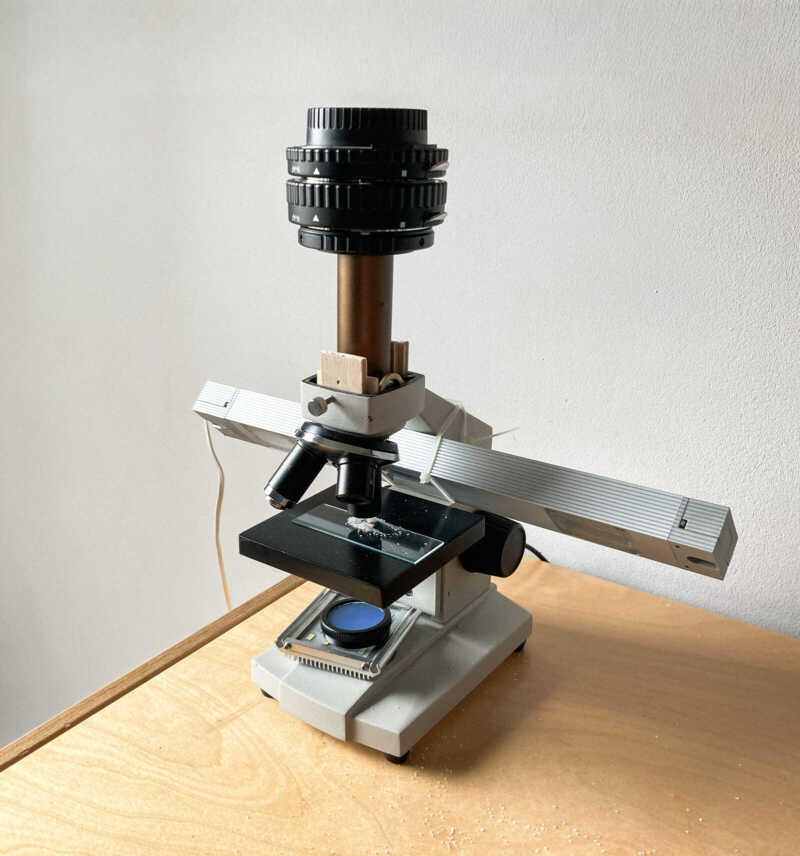
That curiosity began with an interest in photography, which Bielfeldt started exploring at age 17 using an iPhone and inexpensive clip-on macro lenses. In 2020, during the COVID-19 lockdown, he found an old school microscope in his parents' attic. He removed the eyepiece, built an adapter from a tube and some wood, and connected the microscope to an old Nikon D700 borrowed from his father.
Bielfeldt’s first photomicrography setup, 2021
“I just walked around, grabbed stuff from around my house, and put it under there,” he said. “It was really fun.”
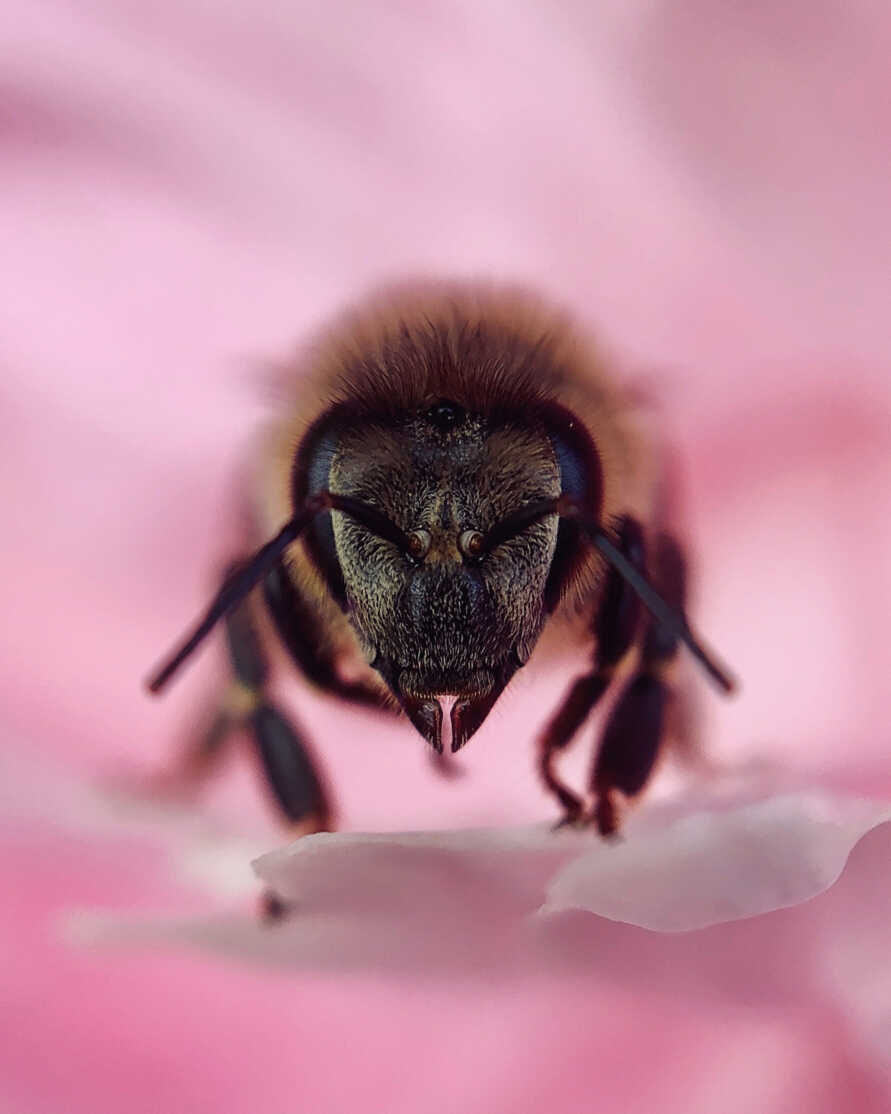
His early experiments eventually led to a project for his mother's beekeeping business, where he photographed bees and the inside of the hive for her Instagram account. One of his iPhone images was even featured by Apple as part of its Shot on iPhone series. He later began posting videos on TikTok, where an early upload gained attention and encouraged him to continue.
Image of a bee featured by Apple as part of its “Shot on iPhone” campaign, 2019.
At first, Bielfeldt experimented with different editing techniques as he found his niche. As he took viewers along on deep dives into the new worlds he had discovered, he also improvised a bit, editing surreal elements into the zoomed-in shots — for example, birds flying within the bristles of a toothbrush. But his followers soon made it clear that they preferred the unedited shots, saying the edited endings took away from the educational aspect of the videos overall. Bielfeldt quickly heeded this feedback and removed those surreal elements from his videos, and has represented video subjects only as they appear in real life ever since.
Now, Bielfeldt studies design in Cologne. He had considered studying art but worried that turning photography into a formal course of study might take away from the hobby. Design offered a different field to explore while still giving him skills and ideas he could bring back to his photography.
He describes his work as experimental photography and videography. Without formal training as a scientist or professional photographer, he has learned largely through YouTube videos, online research, and trial and error.
“I just start experimenting and see what happens,” he said. “I have a picture in my head of what I want to create or what I think or believe something will look like, but in the end, it always turns out differently.”
That approach shaped his winning image. Bielfeldt first became interested in photographing the ink droplets inside a printer after wondering how the machine could produce such precise images. His initial setup proved difficult — the printhead moved too quickly to keep a small area in focus, and the droplets were too fast for his camera's maximum shutter speed of 1/8000 of a second.
“After trying and failing many times to capture the droplets in motion, I thought I would need some expensive equipment,” he said. “But it turned out I already had everything I needed.”
He eventually reverse-engineered the printer, adapting an idea from handheld printers so that the paper moved beneath a stationary printhead. This made it easier to keep the nozzles in focus. To freeze the droplets, he used a flash in a dark room, allowing the brief burst of light to act as the effective shutter.
The resulting photograph revealed details he had not anticipated, including dirty nozzles, uneven droplets, and small shadows cast by ink suspended above the glossy surface of the photo paper. Those imperfections became part of the image's appeal.
Addressing the surreal feel to the winning picture, Bielfeldt rejected Nikon's inquiry about using AI to generate his images and videos. Bielfeldt said he much prefers the uncertainty of photographing real subjects, as well as the challenge of employing classic techniques such as focus stacking, Photoshop, and retouching to create a striking image.
“If the image weren’t real, it wouldn't have any value to it,” he said.
He regularly creates behind-the-scenes videos alongside his photographs, showing how he builds his setups and works through technical challenges. He explained that documenting the process helps viewers better understand the time, experimentation, and problem-solving behind an image.
Bielfeldt demonstrates the functionality of the objective lens and camera setup he created to capture his winning image.
“The idea is somewhat more important than the image quality itself,” he said. “You can go back and remake the same image again later with a better camera, but I think the most interesting part of the process is the initial stage, where you’re trying to figure out how to actually capture something.”
That philosophy informs his advice to aspiring photographers and microscopy enthusiasts.
“I just pick somewhere to start and go for it,” he said. “You're likely going to fail at first, and that’s what makes it even more interesting.”
In his spare time, Bielfeldt is working to develop a custom lens that can transition from approximately 50x magnification to an ultra-wide-angle view without switching objectives. He created his earlier zoom videos by capturing images at different magnifications and combining them in post-production, and the new prototype is designed to create that transition optically and mechanically while maintaining focus.
His goal is to spend less time preparing equipment and more time exploring. Bielfeldt is especially interested in objects that combine mechanical precision with organic movement, including everyday appliances, tools, and other manufactured objects.
Being named the top Nikon Small World winner was unexpected for Bielfeldt, who initially felt like an outsider among participants working in scientific research. His winning image was not created as part of a scientific study, but from a simple desire to understand an everyday object.
He sees the competition's combination of science and art as an important way to bring microscopy to a wider audience. Images can help viewers engage with subjects they might otherwise overlook, while encouraging researchers to consider how to communicate their work visually.
“I'm a very visual learner, and I like to look at things to see how they’re made and how they work,” he said. “I think competitions like Nikon Small World are a great way to catch people with similar visual learning styles, and encourage them to get more interested in something they otherwise might not know about.”
Outside of photography and design, Bielfeldt enjoys climbing, spending time in nature, and working on repairing an old Land Rover Defender 90, which he often takes camping. He also makes a deliberate effort to keep photography connected to enjoyment rather than allowing it to become solely a professional obligation.
“I try to treat it as my hobby as well and not as my work,” he said. “Otherwise, I feel like I would go crazy.”
For Bielfeldt, the next project could begin with almost anything within reach. His work remains guided by a willingness to experiment, build new tools, and look more closely at the familiar.
Prints of Bielfeldt’s work are available for purchase at www.macrofying.com.